Three numbers, not one
"They are cheaper than us" is not an analysis. It is a single point compared against another single point, and it is usually wrong because the two products being compared are not the ones buyers actually choose between.
Price architecture asks three questions instead. What is the cheapest thing a new buyer can start with. Where does the middle of the range sit. And how far is it from the cheapest to the dearest thing they sell.
Those three numbers describe a strategy. One number describes nothing.
Worked on Loop Earplugs
Measured on 24 September 2026, across the products a first-time buyer would call the product, accessories and spares excluded:
Entry price: $23.95. That is the cheapest way in. Low enough to be an impulse rather than a decision.
Median price: $52.95. The middle of the range sits at more than twice the entry point.
Price spread: $185.00. From the cheapest product to the dearest is a hundred and eighty-five dollars.
Read together, that is a deliberate ladder. A rung cheap enough to try without thinking, a middle where the margin lives, and a top end that exists partly to make the middle look sensible.
The ladder moved while we watched
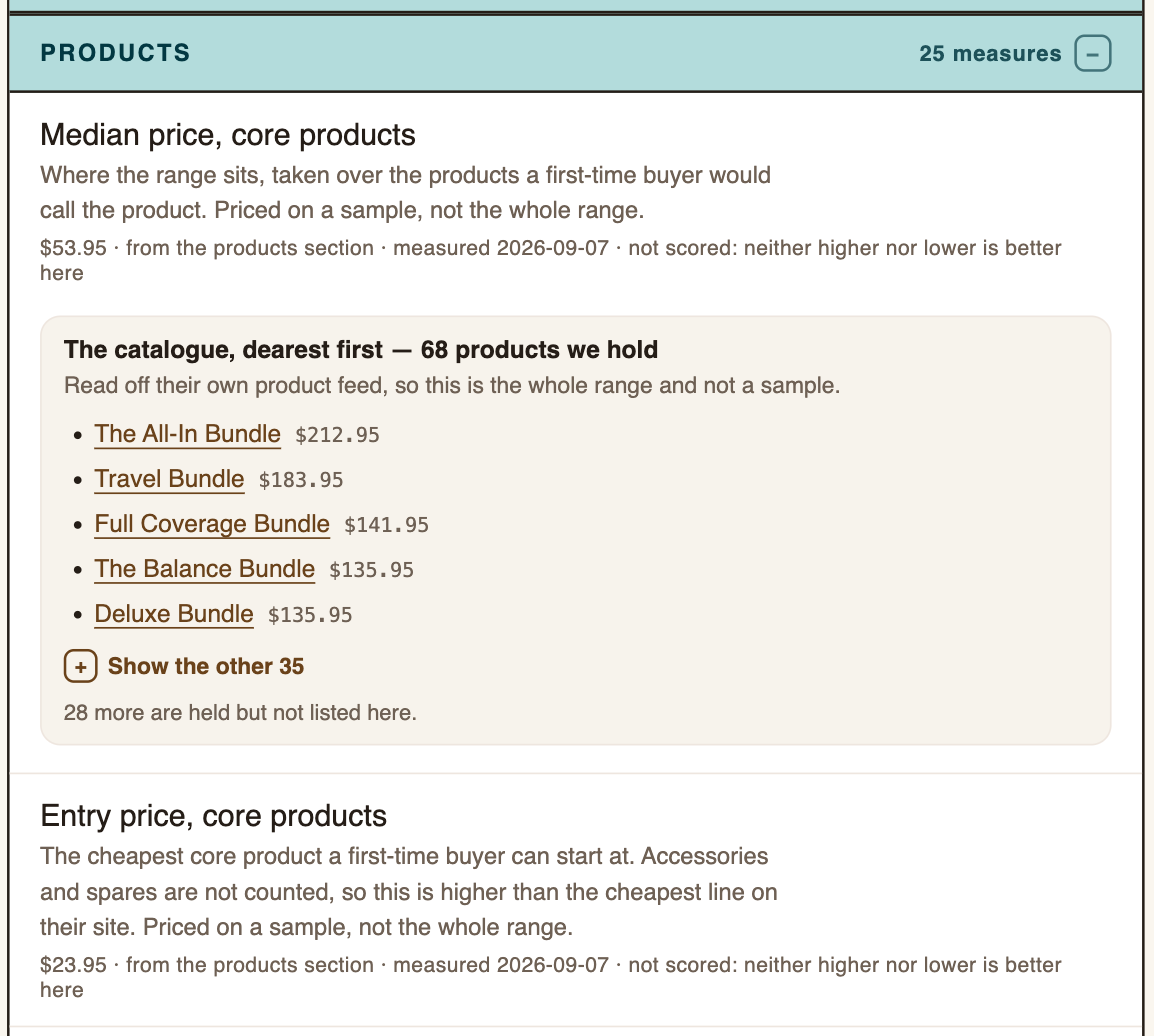
On 7 September the same three numbers were $23.95, $53.95 and $189.00. The entry rung stayed put. The median is a dollar lower, and the top rung, The All-In Bundle, went from $212.95 to $208.95.
Between the report's two pricing snapshots, 38 of their prices moved, and every one of them went down. 18 of the 38 were exactly $1.00, which reads as one decision applied across the range rather than 18 separate ones.
The number that makes the ladder visible
Here is the part that turns three prices into a finding. Only 6% of Loop's running ads carry a discount.
A company with a wide ladder does not need to discount, because it already has a cheaper rung for the price sensitive buyer. Someone who balks at $52.95 is not lost, they are moved down to $23.95. The range does the work that a promotion would otherwise have to do.
Compare that to a company with a narrow range and a high entry point. It has nowhere to send the hesitant buyer except a discount, and discounts train buyers to wait. You can usually see this in the ad library before you see it in the pricing page: the share of creative carrying an offer creeps up because the architecture gives them no other lever.
What to do with it
If their entry price is below yours, you are losing first-time buyers you never hear about, because the loss happens before anyone contacts you. The fix is rarely a discount on your main product. It is a smaller rung.
If their spread is wider than yours, they are capturing buyers at both ends while you serve the middle. A missing top tier is money left on the table by the customer who would have paid more.
If their spread is narrow and their offer share is high, they are buying volume with margin. That is a position you can outlast rather than match.
If their median moved, that is worth more than the level. Loop's is a dollar lower than on 7 September, and none of the prices that moved in the report went up. A median that drifts over a quarter is a company repositioning, and nobody sends a press release about it.
Where these numbers come from
All three are read from the competitor's own store, every week. They sit on the Benchmark next to yours, and the price moves, product by product, sit in the product section of the same report.
That second part matters more than it sounds. A median is only useful if you can see which products moved, because the interesting question is almost always which ones rather than what the average did.
Everything on competitor pricing
Reading a competitor's prices as a strategy rather than a number: the ladder of tiers, the quiet rises, the return window, and the channels where the price is different.
Pick one competitor. See what we find.
Your first benchmark is free. One domain, measured against you, no card and no call.