What goes on the card
A battlecard is not a competitor profile. The seller does not need the founding story or the org chart. They need three things, in this order.
What the other option costs. Not the headline price. The price the buyer will actually end up paying.
What their customers hold against them. In the customers' own words, because that is what the buyer finds if they go looking.
What the other side can prove. So the seller is not surprised by it halfway through the call.
Anything that does not change what the seller says on the call does not belong on the card.
Why most battlecards go stale
The usual card is written once, by product marketing, in a slide deck. Then a price moves or a new tier appears, and a seller quotes last quarter's number to a buyer who checked this morning.
A stale battlecard is worse than none, because it gets used with confidence. The fix is not a more diligent owner. It is a source and a date on every line, so the seller sees what is current before saying it.
Worked on Loop Earplugs
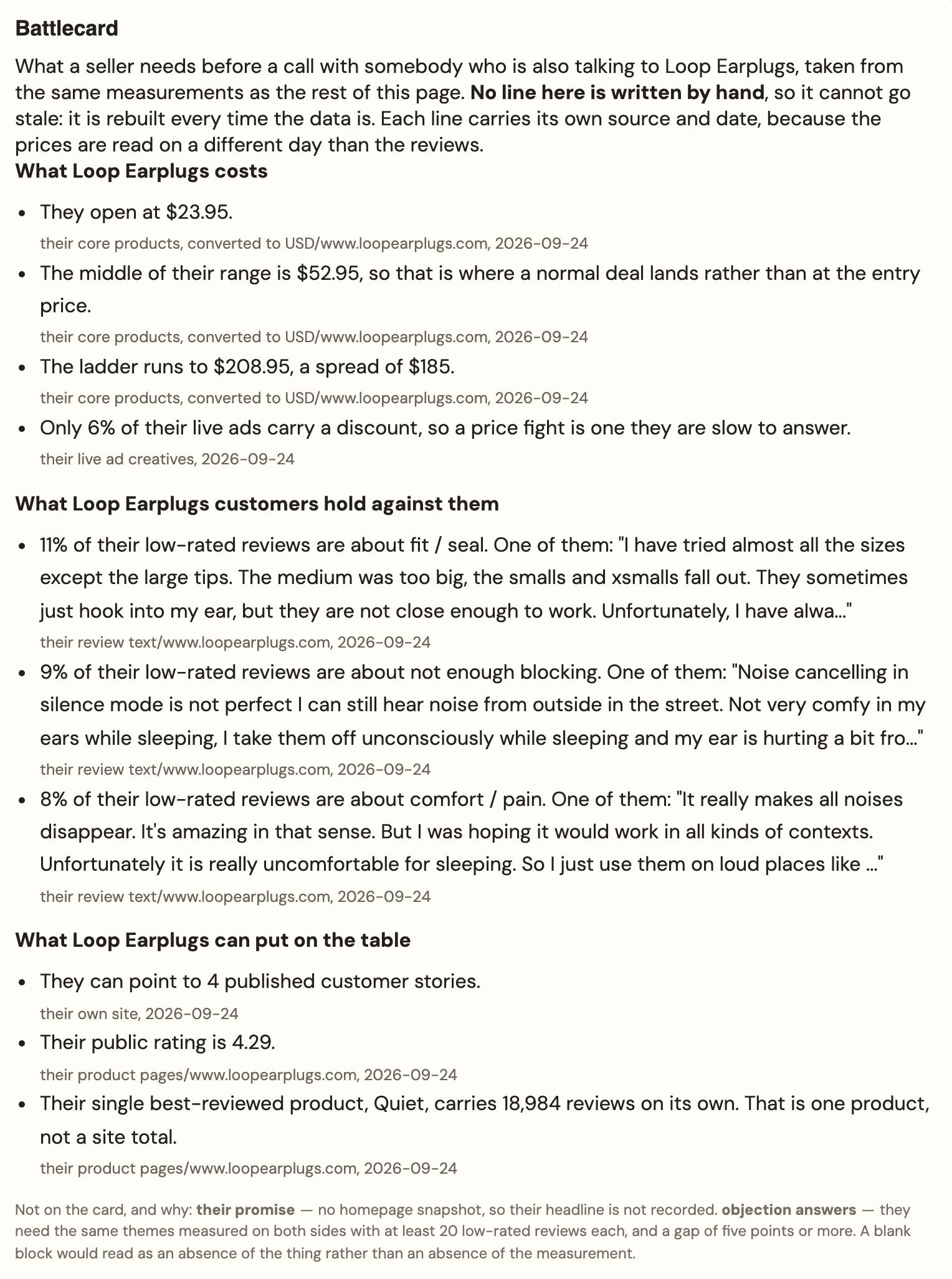
Read from Loop's own store, reviews and live ads on 24 September 2026:
They open at $23.95. The middle of their core range is $52.95, so a normal deal lands at more than twice the entry price. The ladder runs to $208.95.
Only 6% of their live ads carry a discount. The card reads that as a price fight they are slow to answer.
Their unhappy customers name three things. Of their low-rated reviews, 11% are about fit and seal, 9% say they do not block enough, and 8% are about comfort or pain. One of them: "Unfortunately it is really uncomfortable for sleeping."
Their proof is real. Four published customer stories, a public rating of 4.29 on their product pages, and one product, Quiet, with 18,984 reviews on its own.
How a seller uses it
When the buyer quotes $23.95, that is the entry rung, not the deal. Ask which Loop product they are actually looking at, and compare against that one.
When the buyer expects a discount, remember that only 6% of Loop's ads carry one. Do not cut your price to beat an offer nobody has made.
Ask about the complaints instead of stating them. "Have you tried them for sleeping?" does more than "their reviews say they hurt". A buyer who has felt it will say so, and a question is harder to wave away than a claim.
Do not argue with their proof. 18,984 reviews on one product is not something to explain away. Concede it, and move the conversation to fit, which is where their own reviewers complain most.
What is not on the card, and why
Two blocks are missing from Loop's card, and the card says so rather than leaving a gap: their promise, and the answers to objections. The second needs the same complaint themes measured on both sides, with at least 20 low-rated reviews each.
That note matters more than it looks. An empty box reads as "they have nothing here" when the truth is "nobody measured it". A seller who cannot tell the two apart walks into the call with the wrong one.
Where these numbers come from
Prices from their store, across their core products, converted to dollars. Complaint themes from the text of their low-rated reviews, grouped and counted. The discount share from their live ad creatives. Stories and rating from their own site. The card is rebuilt every time the data is, and it sits on Loop's benchmark.
For the call itself, the note on answering a cheaper rival picks up where the card stops.
Pick one competitor. See what we find.
Your first benchmark is free. One domain, measured against you, no card and no call.