What the map asks
A customer journey map follows one buyer from first hearing of a brand to the second order. Five stages: discovery, consideration, evaluation, purchase and retention.
At each stage it asks what the buyer sees, and what the brand does to move them on.
Why the usual version misses the rival's
For your own company, the map runs on your analytics and your CRM. For a competitor, none of that exists, so the usual workaround is a workshop where the team guesses. The guesses tend to look like your own funnel with their logo on it.
The honest version uses only what a stranger can observe: what they publish, what they pay to show, and what lands in an inbox after signing up. Every line needs a source, and a stage with no source should say so instead of being filled in.
Worked on Loop Earplugs
Read on 24 September 2026:
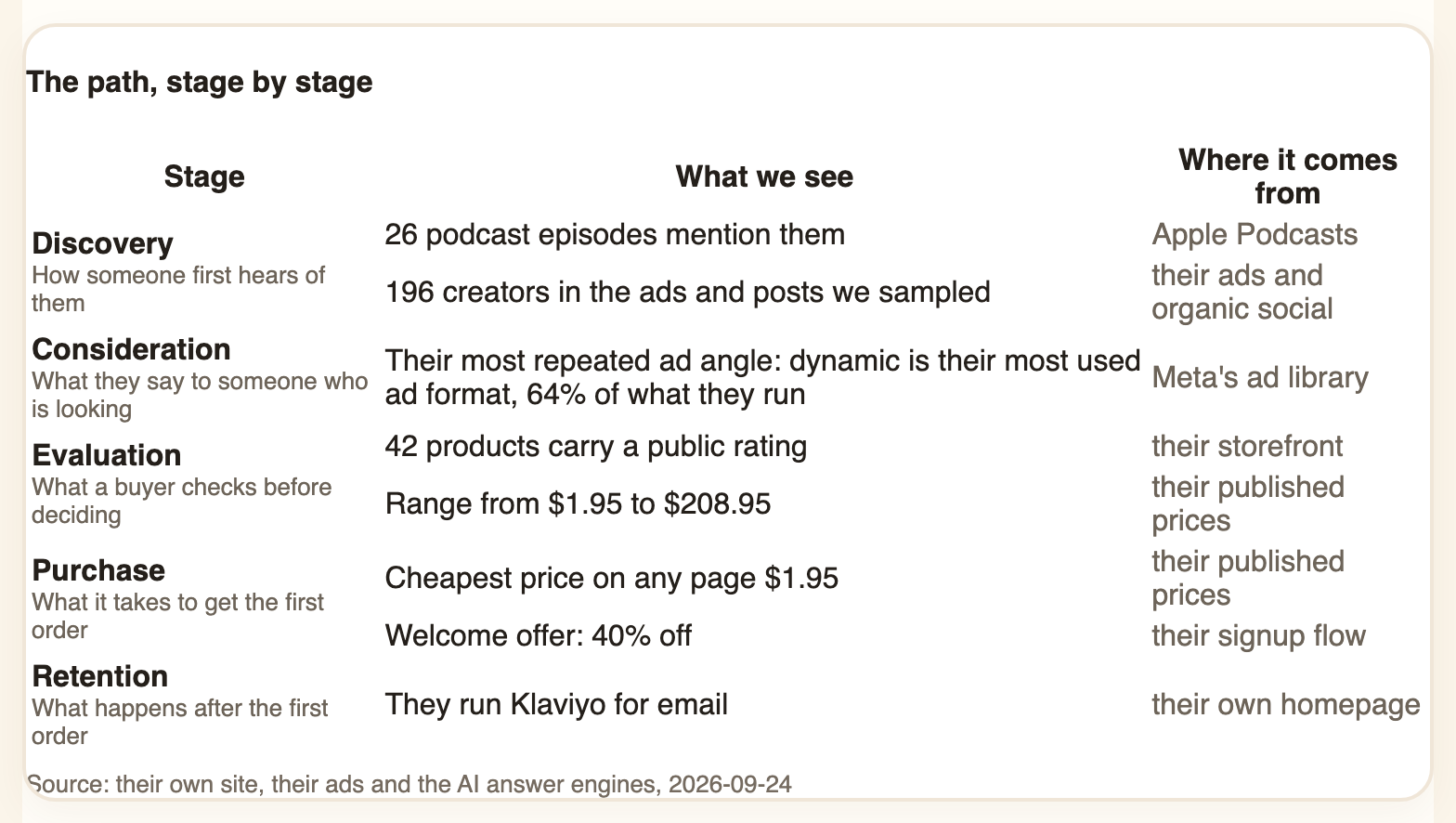
Discovery. 26 podcast episodes on Apple Podcasts mention them, and 196 creators turn up in the ads and posts sampled. Similarweb's model puts search at 49.4% of visits in August 2026, but the top five search terms are all variations of their name, so search is where people land after hearing of Loop elsewhere.
Consideration. Dynamic catalogue ads are their most used format, 64% of what they run in Meta's ad library. The page their ads point to most is the Tomorrowland 2026 collection, with 12 ads behind it, and three ads send people to a quiz.
Evaluation. 42 of the 50 products scanned carry a public rating, out of 68 in the catalogue. On their own store the score is 4.33, weighted by review count. On Trustpilot it is 3.6 across every review and 2.58 across the 300 newest, where 65% are unhappy and none has a reply.
Purchase. The cheapest price on any of their pages is $1.95, but that is an add-on. The cheapest earplugs are $23.95. The signup flow offers 40% off.
Retention. One line: they run Klaviyo for email. A seeded address on their list received 22 emails between 18 August and 24 September 2026, 3.7 a week over the last 30 days.
Where the discount went
Only 6% of Loop's live ads carry a discount. The signup flow offers 40% off. And of those 22 emails, 13 named a percentage off, from 10% to 40%, six of them at 40%.
The discount has not gone. It has moved out of the ads, where every competitor can see it, and into the popup and the inbox, where only someone who handed over an email address does.
What to do with it
Compare yourself with the signup price, not the ad price. A benchmark built from their ads and product pages alone measures what a stranger pays, not what a subscriber is offered.
Sign up to their list yourself. 22 emails since 18 August is a pricing calendar: when they discount, and by how much, before a buyer quotes it back to you.
Meet them where their proof is weakest. Their own reviews average 4.33. The newest Trustpilot reviews say 2.58. If your own off-site reviews hold up, that is the page to send buyers to.
Treat a thin stage as unmeasured, not simple. Consideration and retention have one line each. That marks where the outside view runs out, not where Loop does little. Walk through their quiz yourself.
What it cannot tell you
A journey drawn from outside is what a stranger can observe, not what their funnel does. It shows the offer on the popup, not how many took it. The emails are one subscriber's view, and a brand that segments its list sends things one address never sees.
The journey, with a source on every row, sits on Loop's benchmark. The 6% line comes from their battlecard, and their price ladder, from $23.95 up, is covered in price architecture.
Pick one competitor. See what we find.
Your first benchmark is free. One domain, measured against you, no card and no call.