Two axes every buyer already sees
A perceptual map places the options in a category on two dimensions buyers choose on, then looks for clusters and for empty space. The textbook version asks buyers where they would put each brand. That is a survey. It is expensive, and it is out of date by the time it reaches a slide.
Price and review score need no survey. Every buyer sees both on every product page, before they read a word of copy. Both are public, both move, and both can be read again next week. The report calls it a positioning map. It is the same tool.
Plot products, not brands
Most maps give each brand one dot. That dot is an average, and the average hides the thing you came to see.
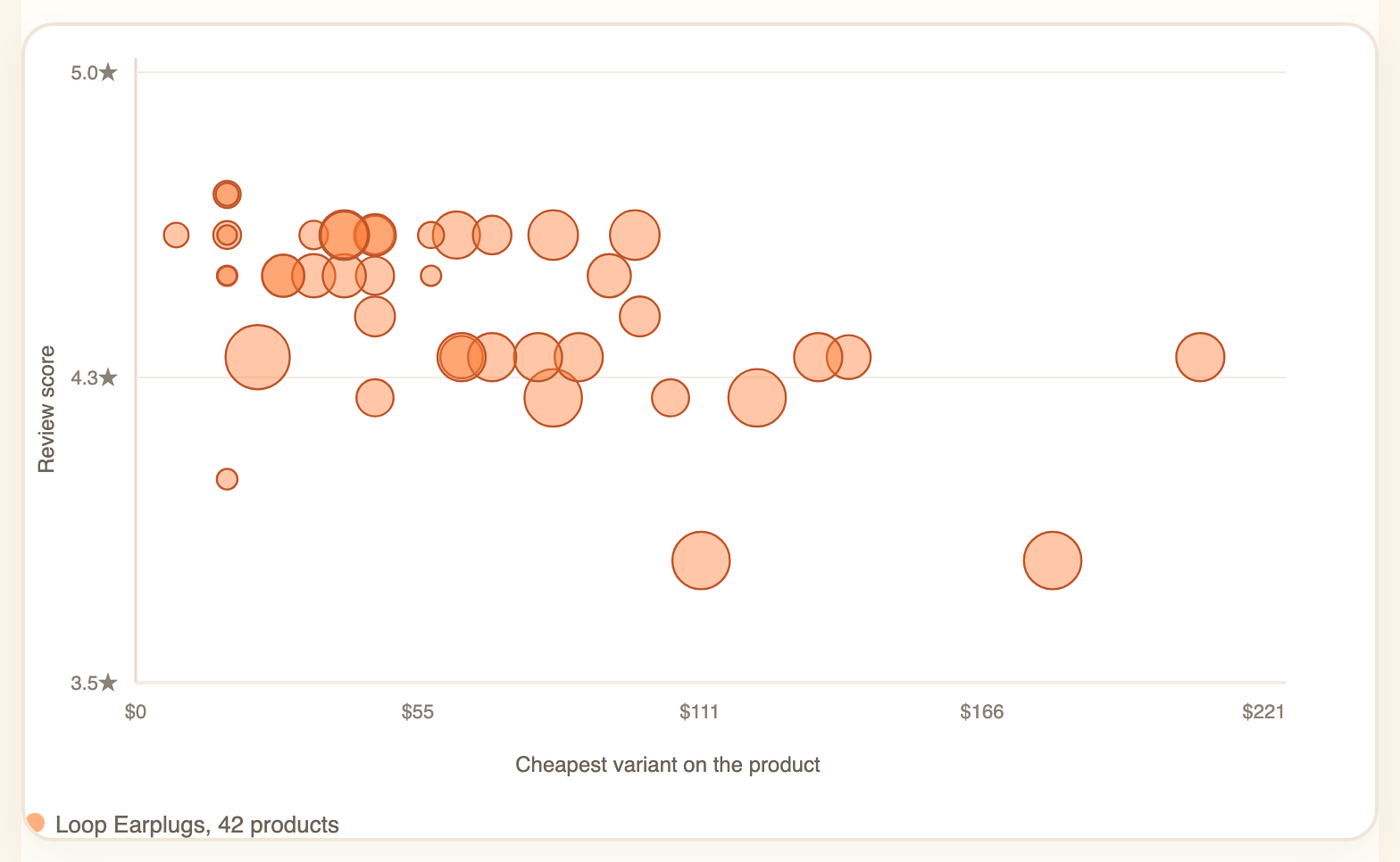
On 24 September 2026, 42 of Loop Earplugs' 68 products had both a price and a review score. They run from $7.95 to $208.95, and from 3.8 to 4.7 stars. A single Loop dot would land somewhere in the middle and describe none of them.
A brand is a cloud, and the shape of the cloud is the positioning.
What Loop's cloud says
The stars do not rise with the price. Every Loop product above $100 sits at 4.3 or lower. Every one rated 4.6 or higher costs less than $100.
The music editions sit near the top. The Coachella, Tomorrowland, Amnesia Ibiza and Pleasing editions and the Festival Bundle all score 4.5 or 4.6. Only two $17.95 accessories score higher.
The two lowest dots are bundles. The Good Night Bundle at $110.95 and the Travel Bundle at $179.95 both sit at 3.8, the bottom of the map. The Rest & Relax and Cocooning bundles sit at 4.2.
The map does not say why. Their low-rated reviews suggest where to look: not blocking enough and comfort are two of the three biggest complaint themes on Loop's battlecard, and one reviewer writes that they are "really uncomfortable for sleeping".
What to do with it
Put your own products on the same axes. Your buyer does not compare you with Loop. They compare your product with the Loop product at the same price. The nearest dot to each of yours is the comparison that product page has to win.
Look at the empty corner. Above $100 and above 4.3 stars, Loop has nothing. That does not prove buyers want something there. It does mean nobody at Loop is defending it.
Read the bubble before the star. The Dream ear tips score 4.7 on 217 reviews. Quiet scores 4.3 on 18,984. Those are not the same claim, and buyers know it.
What the map cannot tell you
A review score is not quality. It is the score of the people who chose to leave one, shown by a widget the brand runs on its own store. Products without reviews are missing rather than plotted at zero, so a new launch looks like nothing even while it sells.
And the bubble is not always the product's own. On Loop's store, the Engage 2 Sublime, the Paris Hilton edition and The Spooky Bundle all show the same 5,589 reviews. The bubble tells you how much proof a buyer sees on that page, which is what shapes the decision. It does not tell you how many people bought that exact product.
Prices are the cheapest variant of each product in their catalogue. Scores and review counts come from the review widget on each product page. The map and the table behind it sit on Loop's benchmark, and the note on building a market map covers drawing a whole category instead of one brand.
Pick one competitor. See what we find.
Your first benchmark is free. One domain, measured against you, no card and no call.