A position you cannot see from inside
Every other channel leaves a trace in your own data. Search sends you sessions. Ads send you clicks. Even word of mouth shows up eventually as direct traffic.
An answer engine that considered you and recommended someone else leaves nothing at all. There is no impression, no bounce, no lost session to notice. From inside your business, being invisible to a model looks exactly like a quiet week.
Loop Earplugs currently gets 0.7% of its estimated visits from AI assistants. Small. That number is the tail, not the position, and reading it as the whole story is the mistake: most people who ask a model for a recommendation act on it later, through search or directly, and arrive with the brand already chosen.
Worked on Loop Earplugs
Measured across five engines and 18 buying questions a real customer in that category asks, read on 24 September 2026:
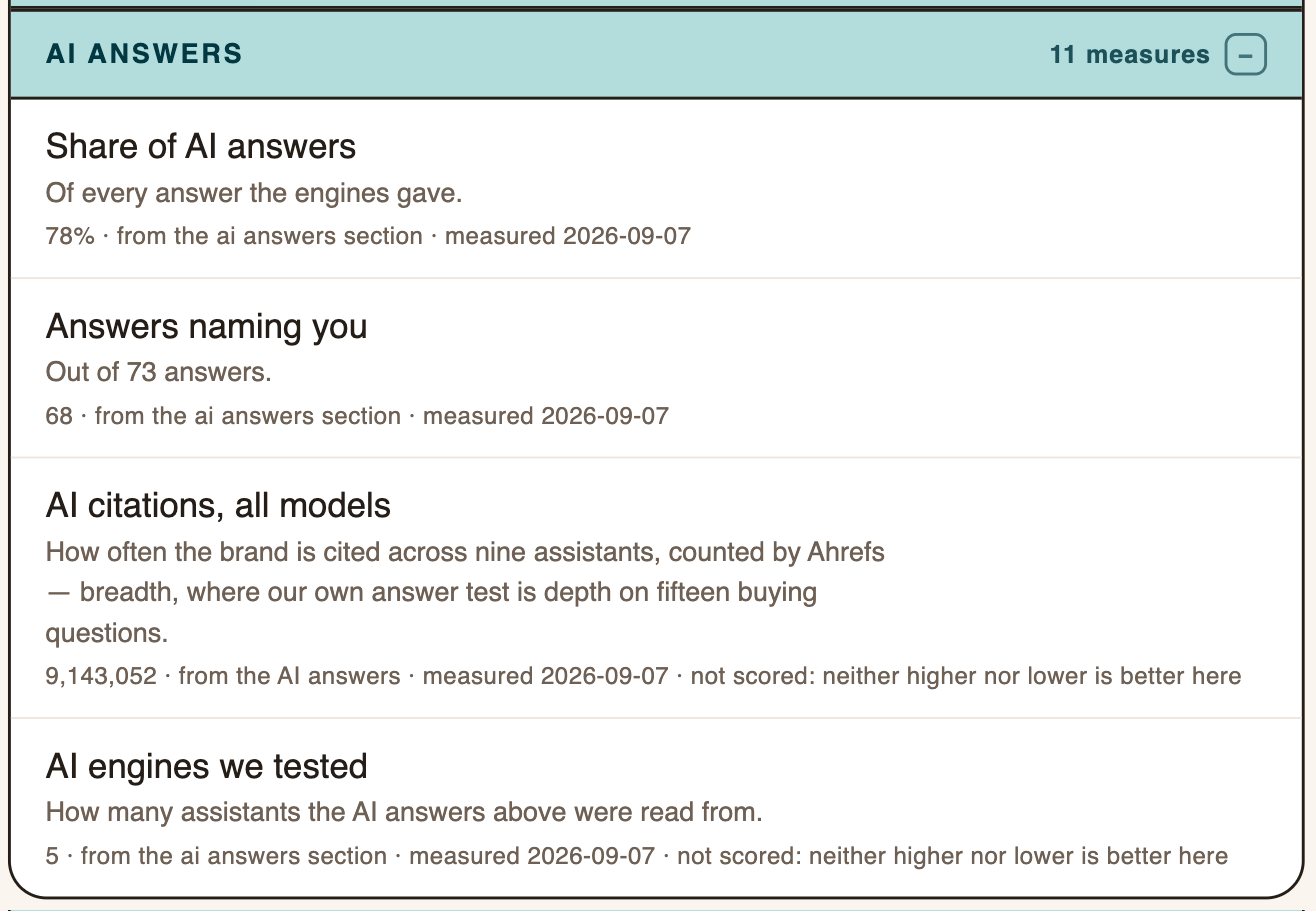
Share of AI answers: 79%. In almost four of every five answers we tested, Loop is named.
Named in 70 of 89 answers. Not a percentage floating free: a count of the specific answers where the brand appears, each one stored.
That is a dominant position, and it is dominant in a place no competitor's analytics will ever show them losing.
The three questions worth asking
Are you named at all? The binary is the important one. Not being mentioned is not a low ranking, it is absence, and it is far more common than most brands assume for anything outside the top two or three in a category.
Are you named first? Order matters in an answer the way it matters on a search results page, and for the same reason: most people stop reading.
Which questions do you lose? This is where the work is. A brand is rarely absent everywhere. It is absent on the specific questions it has not earned, usually the ones framed around a situation rather than a product. Those are individually winnable, which is what makes them worth listing.
Why the engines have to be kept apart
They disagree, and averaging the disagreement away destroys the finding. A brand can be named in almost every answer on one engine and missing from another, because each one reads different sources before it answers. On the same questions in the same week, Loop was named in 89% of Perplexity's answers and 67% of Microsoft Copilot's, and Mack's went from 44% on Gemini Search to 0% on Perplexity.
That is also why the sources matter as much as the answers. The domains an engine cites before naming anyone are a map of where the argument gets settled, and they are frequently not the places a marketing team is spending its time.
The claim has to be checkable
This is the area where it is easiest to sell a number and hardest to prove one. An engine's answer varies with phrasing, and a percentage with no receipt behind it is worth nothing.
So every answer is stored word for word, with the exact prompt that produced it and the sources the engine cited. If a report says a brand was recommended, you can open the sentence and read it. The questions themselves come from the category, your catalogue and what your reviewers actually write, and you approve the list before anything is measured.
A share of answers you cannot open is marketing. A share of answers that opens into the answers is a measurement.
Where these numbers come from
The same buying questions, asked on the same engines, every week. The shares and counts sit on the Benchmark alongside your own, and the individual answers, with prompt, response and cited sources, sit under the same band, one click below the share.
And because it is asked weekly, the movement is available. A share dropping from 79% to 60% over a month is the kind of thing that shows up in revenue two quarters later, and nowhere else in between.
Everything on AI visibility
Whether AI assistants name you when a buyer asks, how much the engines disagree, and the traffic from them that your own analytics cannot see.
Pick one competitor. See what we find.
Your first benchmark is free. One domain, measured against you, no card and no call.