
Read what they do, not what they say
Most attempts to analyze competitors end as a feature table. It compares their claims with yours, it is out of date before anyone has shared it, and it never says what to do next.
A competitor tells you far more through what it pays for, which pages it builds and where its prices go. None of that is on the About page. All of it is public.
Below are nine places to read, each with one dated finding from Loop Earplugs, our worked example. This is not a process. For that, read how to do a competitive analysis, step by step and how to research your competitors in four steps.
Before you analyze competitors, pick one
Most guides, The Growth Syndicate's framework among them, tell you to list five to ten competitors. Start with one: the one that turns up on the same shortlist when a buyer decides between you.
Then keep it for fourteen days. Most of the nine readings below say little on the first day and a lot on the second, because the finding is usually the change, not the level. Research on one rival you keep is worth more than research on ten you abandon.
The 9 things to read
Numbers come from Loop's benchmark, and each carries its own date: store, prices and AI answers are from late September 2026, traffic is August, and the ads were collected on 6 and 24 September.
1. Their price ladder, not their price
What to look at: the cheapest way in, the middle of the range, the distance from cheapest to dearest, and which products move.
Where it is free: their own store's product and collection pages.
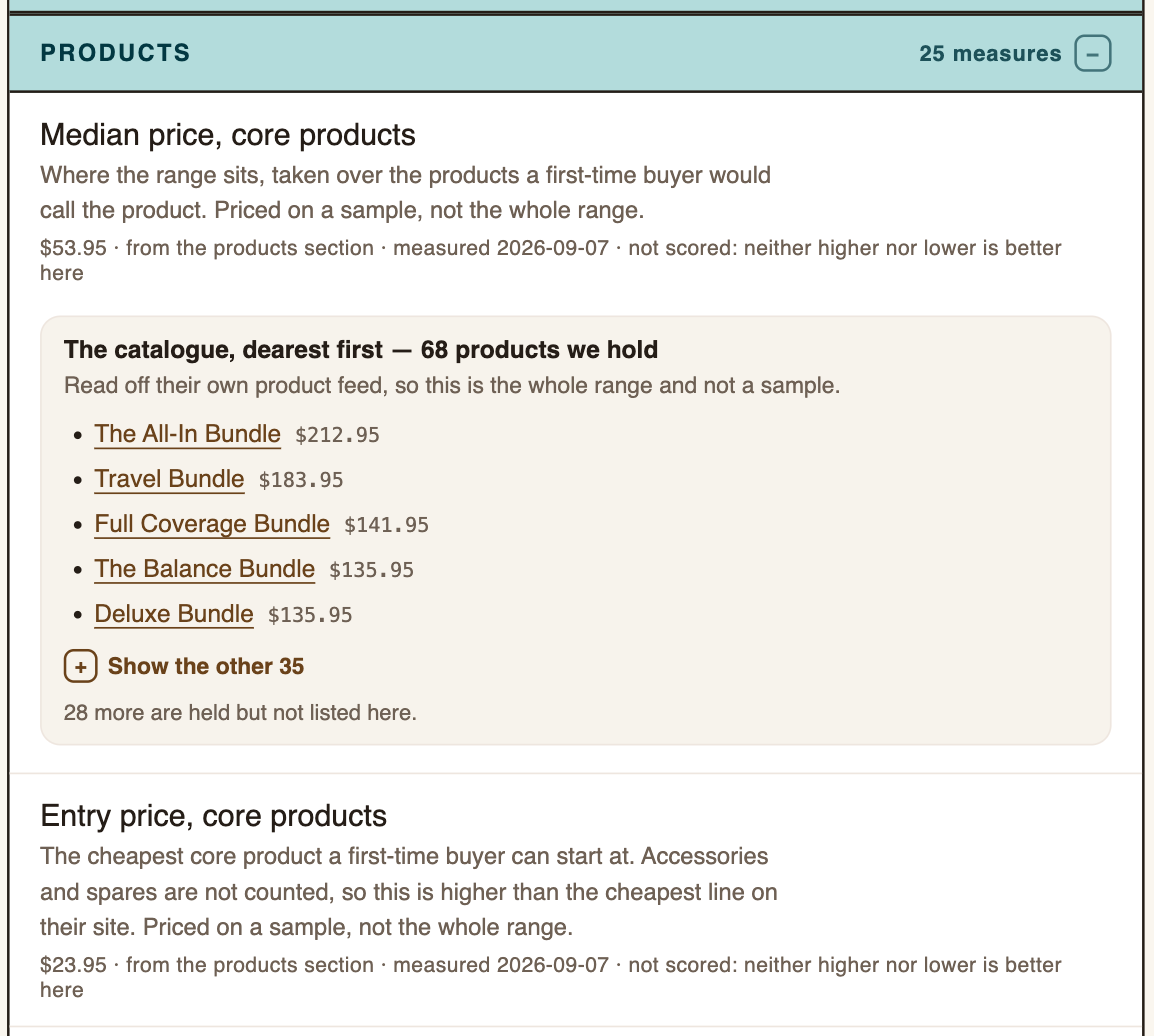
What we found: Loop sells 66 products, with a median core price of $52.95 and a spread of $185. Between the price snapshots of 15 and 24 September, 38 products dropped in price, and none moved in the three days after. 18 of those 38 moved by exactly -$1.00: one change landing on 18 products rather than 18 decisions. The biggest cuts were $4.00, on the Travel Bundle ($183.95 to $179.95) and The All-In Bundle.
What to do: compare your ladder rung by rung, not your hero product against theirs, and count a move once when it is one decision. More in competitor pricing analysis: read the ladder.
2. The ads they never switch off
What to look at: how long each ad has been running, not how many there are. Nobody keeps paying for an ad that loses.
Where it is free: the Meta Ad Library, searched by their page name, shows their active ads and when each started running.
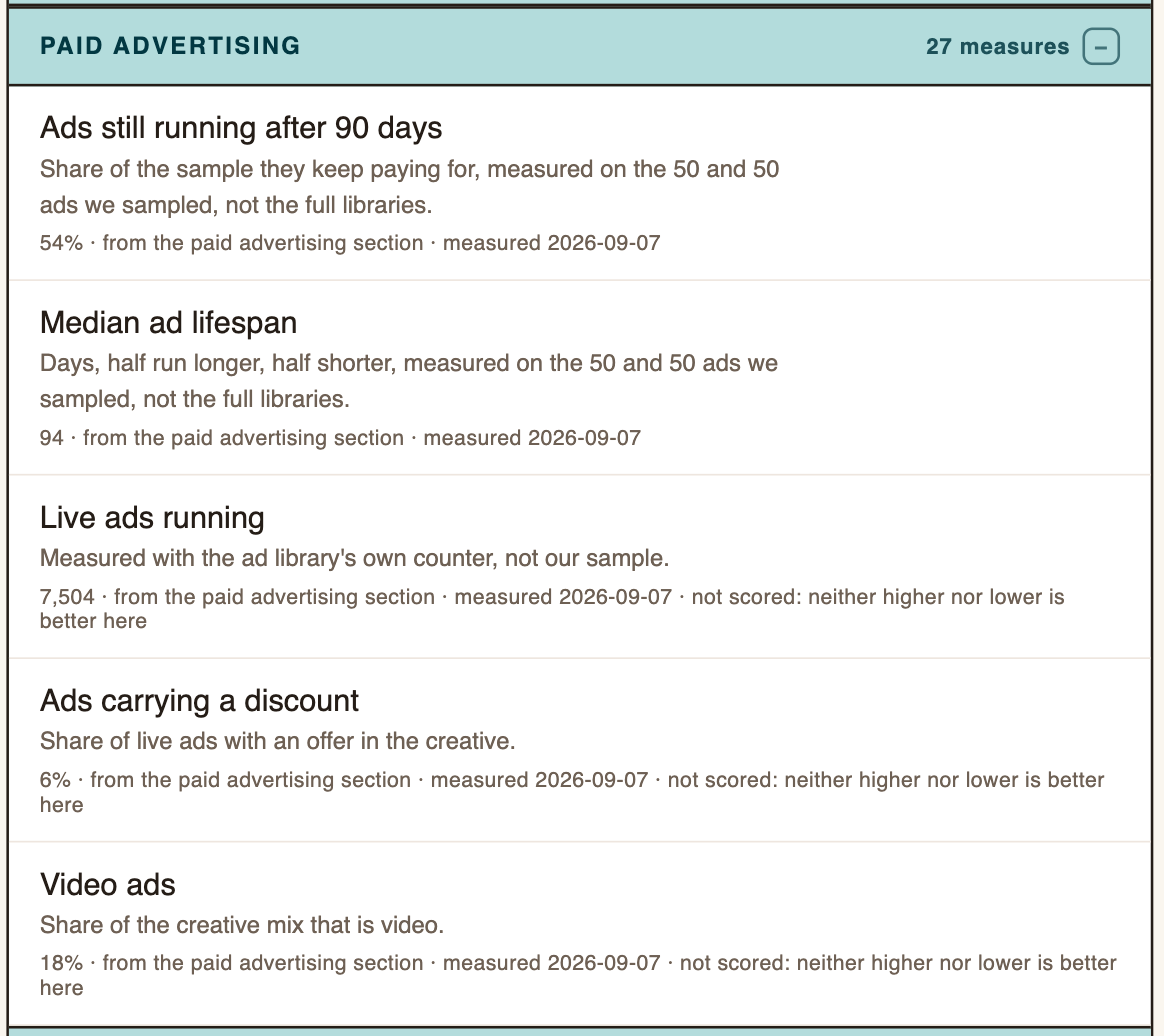
What we found: 6,989 live ads in Meta's library on 24 September 2026, down from 7,504 on 6 September. In the ads we collected on 6 September, the median had run 93 days and the longest 146, and only 6% carried a discount.
Of 50 ads analyzed in detail, 29 are catalogue ads rotating store products with no discount at all. The discount moved into the signup popup and the inbox: 22 emails since 18 August, about four a week.
What to do: read their oldest ad as a message they already tested, and sign up to their emails to see where the offer went. See what they refuse to switch off, the creative testing framework and follow the discount.
3. Where their traffic comes from
What to look at: the channel mix and the countries, more than the visit count.
Where it is free: Similarweb publishes a traffic estimate for most sites. It is a model, not a measurement, so label it as one.
What we found: about 4.4 million visits in August 2026, as modelled by Similarweb, 2.2% fewer than in July. Search brought 49.4%, direct 18.0%, social 13.2%, display ads 9.0%, email 6.3%, referral 2.1% and affiliate 1.3%. The US sent 34.7% of visits.
What to do: compare shares with your own analytics. A 2.2% dip in a modelled number is not a trend. A channel where they get 9% and you get nothing is a question. See how to see how many visits a competitor gets and why we publish a band.
4. What they publish for search
What to look at: which pages they have indexed, what kind, and what is new.
Where it is free: their sitemap, usually named in their robots.txt file, lists the pages they want found.
What we found: 9,996 indexed URLs, of which 3,500 are blog posts, 4,804 landing pages and 672 collections.
What to do: group their pages by topic and look for topics where they have dozens of pages and you have none. Between readings, watch the new URLs: a cluster of fresh landing pages is a campaign before it is an ad. More in they have 133 articles on one topic.
5. What AI answers say about them
What to look at: whether they are named, whether they are named first, and how they are described.
Where it is free: the answer engines themselves. Ask the questions your buyers ask, in the same words each time.
What we found: across 18 buying questions on five engines, Loop appears in 79% of answers. Where it appears, it is named first 69% of the time and framed positively 37% of the time.
What to do: being named is not being recommended. Find the questions where they are named without praise, or not at all, and write the page that answers them. See share of AI answers.
6. What their customers complain about
What to look at: the low-star reviews, grouped by theme and counted. Not the average.
Where it is free: their Trustpilot profile and the review widget on their own product pages.
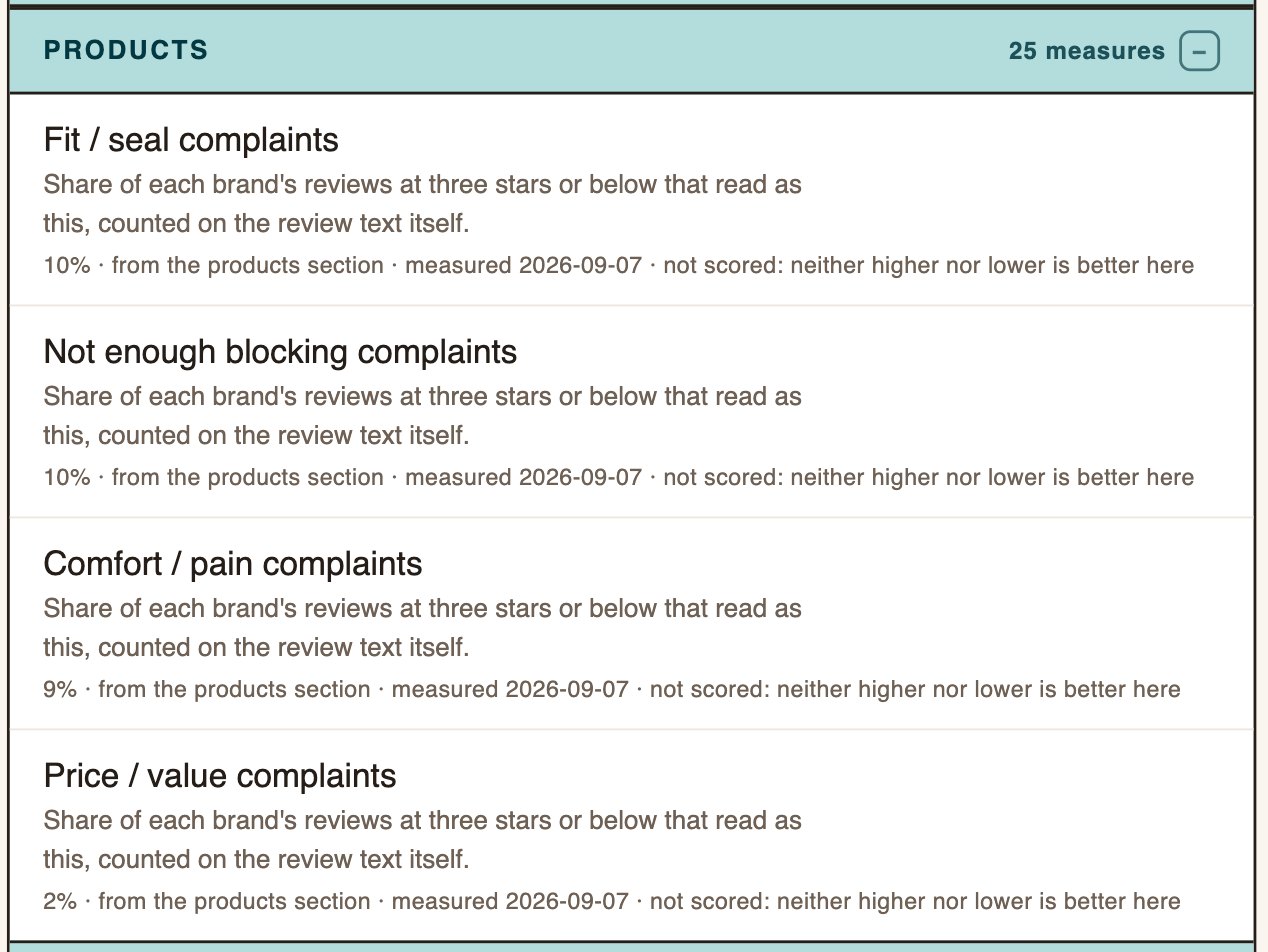
What we found: the store average is 4.35. Trustpilot shows 3.6 across 8,133 reviews, but only 2.58 on the newest, with 108 new reviews in the last 30 days. On 24 September, 282 of 2,500 store reviews read were three stars or below: fit and seal 30, not enough blocking 25, comfort and pain 23, sizing and tips 10, price and value 10, case and durability 6.
What to do: the top three themes are all about wearing the product. The six themes cover 104 of the 282; the rest name no single theme. Price is 10 of them, so cheaper is not the opening their unhappy buyers ask for. More in voice of customer analysis and one complaint kept coming back.
7. Who they hire
What to look at: which roles open and close, and the share by function.
Where it is free: LinkedIn jobs and their own careers page.
What we found: 19 open roles, 37% in sales and marketing and 21% in engineering. In 18 days, 13 roles opened and 18 closed.
What to do: read titles and locations as a roadmap. The first hire in a new country says more than a press release, and a list that turns over this fast cannot be read once a quarter. See job posts as a roadmap and their job ads name the tools.
8. Who talks about them, and who is paid to
What to look at: creators, press and podcasts, and which of them were paid.
Where it is free: Instagram and TikTok, where paid posts are meant to carry a label, a news search, and podcast directories.
What we found: 841,971 Instagram followers, 281,600 on TikTok and 169 creators around the brand. 63 press articles, 17 in major outlets. 26 podcast episodes name them, 2 of them sponsored. The week to 25 August was the launch week of the Paris Hilton x Loop edition on Instagram and Facebook, with one post drawing 953 comments.
What to do: separate what they bought from what they earned. 24 of those 26 podcast mentions were not sponsored. See how to tell a paid creator from a real fan and the conversation you are not in.
9. What they promise on their own site
What to look at: the return window, shipping terms, warranty and the claims on the homepage, read as numbers.
Where it is free: their policy pages, usually linked from the footer.
What we found: Loop gives buyers 100 days to return a product.
What to do: put your terms next to theirs. A buyer weighing two brands looks at the return window as well as the price, and a longer window is not something a discount answers. See why compare prices and not the return window.
How to tell a real move from noise
We got this wrong on our own pages first. Three traps that look like findings.
A sample that looks like a movement. If you read five of their ads each time and they are five different ads every time, the "new creative" is your sample changing, not their strategy.
A value saved again without being fetched again. It looks exactly like "unchanged".
A small swing. +0.04 on a rating is noise.
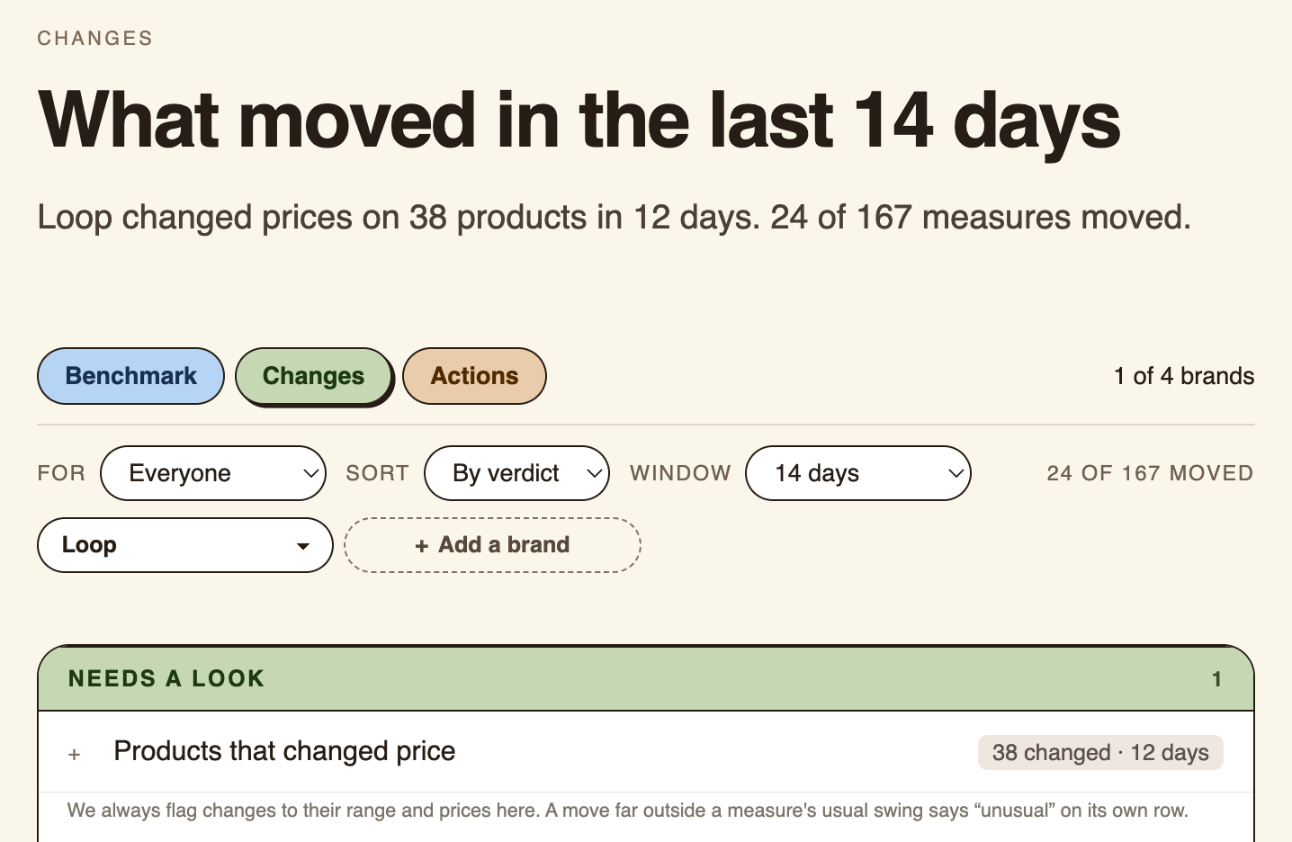
A measure has moved only when the move is bigger than its own usual swing. Applied to Loop, that rule leaves 24 of 167 measures as moved in the 14 days to 28 September, the number at the top of their Changes page below.
Two from Loop this month that fail the test. Google Trends interest in "Loop Earplugs" fell 52% week on week, but only after a one-day spike on 20 September, so it is the spike ending, not a decline. Their backlinks, 15,954, and referring domains, 3,342, both jumped on 24 September, mostly nofollow links. We cannot yet tell an Ahrefs recount from real links, so we do not use it.
The 38 price changes pass: a count of products, not a sample.
Turn it into three decisions
Nine readings produce more observations than anyone will act on. Turn each observation into a gap, a difference with a direction, then sort by how wide the gap is against what it costs to close. Steps five and six of the process cover the sorting.
From the Loop readings alone, three candidates stand out. Answer the fit and comfort complaints in your ads, because their buyers named them and price is not the objection. Write for the questions where engines name Loop without praise. And look hard at your return window before you touch your price.
Three moves with a measure and a date beat forty parity items.
How often to look again
The same framework treats six months as the point where competitor data goes stale. For prices it is closer to two weeks: Loop moved 38 of them in 12 days. On the job list, 13 roles opened and 18 closed in 18 days.
Read the one competitor every fourteen days, the same way each time, and the rest of the field once a quarter.
Four mistakes that waste the work
Only reading the obvious rivals. The one taking your buyer may be the brand an answer engine names first.
Analyzing without a decision. It ends as a deck admired once.
Looking for what you already believe. If every reading confirms your plan, check how you chose the readings.
Copying instead of standing apart. Closing every gap makes you a worse version of them. See should you copy your competitors.
FAQ
How many competitors should you analyze? One to start, the one a buyer compares you to.
What tools do you need? A browser and a spreadsheet with a date column. Tools save the repetition, not the reading.
How long does it take? The first reading takes longer than you expect, because you are finding the sources. The second is quicker, and it is the one that shows movement. It is also the one that gets skipped.
Is it legal to analyze a competitor? Keep to public sources. Do not book fake demos, do not pose as a customer to extract pricing, and do not question their staff. This is how we work, not a legal verdict.
Pick one competitor. See what we find.
Your first benchmark is free. One domain, measured against you, no card and no call.